is an independent, co-educational environment.
is that the children of our community go into the world knowing that we are all responsible for one another’s welfare, for the stewardship of all that surrounds us and with a wisdom regarding how we are each tasked with the work of creating a world that will be more peaceful than we found it.
we follow the Lebanese and International curriculum. We have our own evaluation system and clear rules about how we behave towards each other. We have high standards, and we know how to motivate and inspire. The desire to learn is essential for us and the student’s own curiosity is the key. Therefore, we want to be the school you are longing for. We are a place for explorers, freethinkers, and independent innovators.
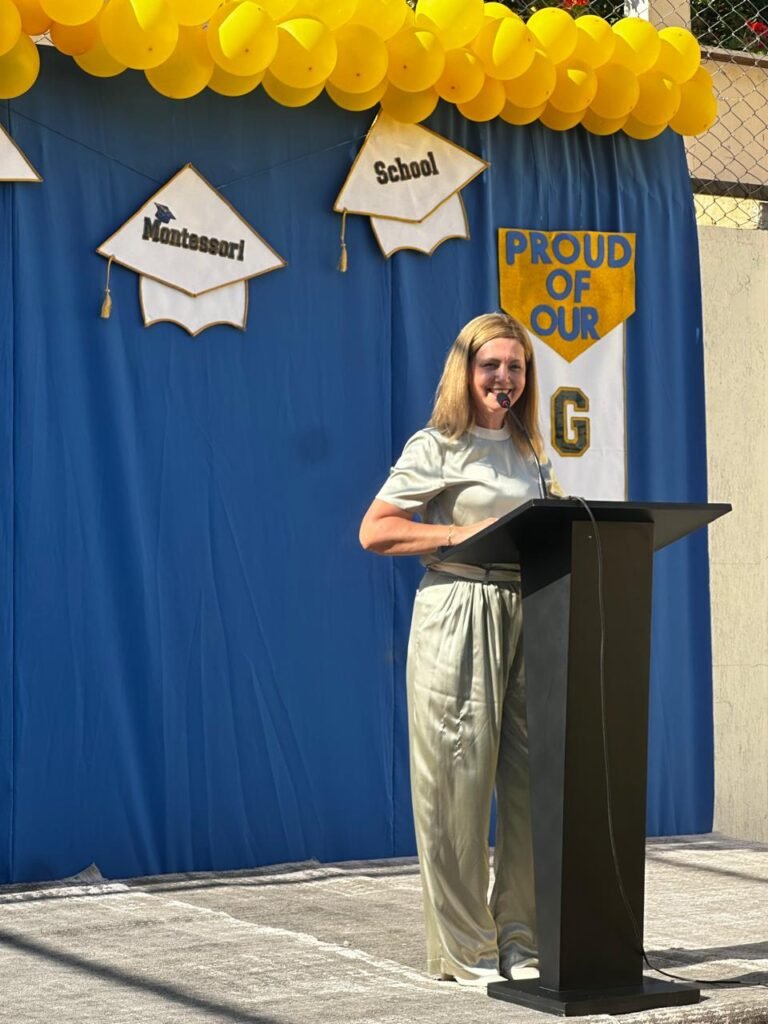
Director
Lebanese Montessori School is dedicated to providing an enriching and challenging educational environment where each child is encouraged to grow to his or her fullest potential academically, emotionally, and socially.
We know every child is different. So at Lebanese Montessori School, every child’s unique set of skills and interests are utilized to his or her advantage in the way that they learn, grow, build self-esteem, and develop their imagination.
The Montessori method encourages all children to develop their own skills at a pace they set and is rooted in a core belief that education should not only impart knowledge, but must always strive to unlock human potential.
“All we have to do is set the energy free…”
Sincerely,
The Lebanese Montessori School
We educate children from Pre-School age up to Grade eight (Aged 3-14).
Programs include children house, lower elementary, upper elementary and middle school as well as special education (SE) program.
We follow the Lebanese and International Curriculum, using the Montessori Method and Philosophy.
Children learn English, Arabic, and French from Pre-School age, using the language immersion technique and Montessori pedagogy.
holding internationally recognized Montessori certificates (Association Montessori International, AMI) and additional staff members support the vision of creating an environment that aids children’s development in a way that is the product of the child’s own intellectual, emotional and spiritual work.
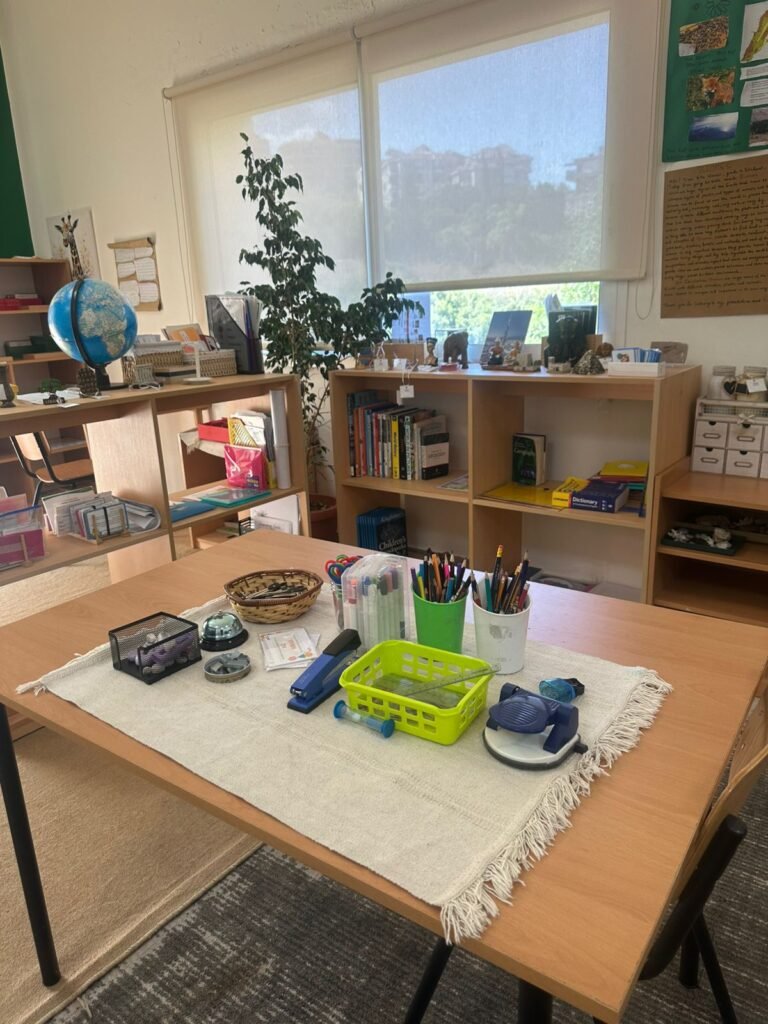
We have an age-appropriate outdoor space and garden with an interesting design. Our classrooms are equipped with Montessori materials. These environments are prepared for children at each developmental level, and allow them to take responsibility for their own education. As a result; our students develop a life-long passion for learning.
-Maria Montessori
-Maria Montessori
Our educational approach is centered around the stages of human development. This approach includes keeping abreast of current theories on development, regular student observation, and a constant evaluation of the curriculum to ensure that it is appropriate for the developmental stages of our students.
We follow the Montessori curriculum, which by design is adaptable to different paces and styles of learning. Each child works within an established curricular framework that includes the school’s expectations for basic academic achievement.
We promote active rather than passive (“lecture and drill”) learning by:
• Encouraging students to pursue studies in areas of their personal interests;
• Using hands-on, experiential learning, such as concrete manipulative learning materials, experimental discovery seminar discussions, independent library research, field investigation;
• Creating an environment in which the child’s personal success is the motivation for learning.
2.1.1. We encourage children to make responsible choices for themselves, to recognize that they are assuming increasing control over their lives as they mature, and to discover how to make a positive contribution to the world around them.
2.1.2. We encourage our student to be open-minded and compassionate, to gain a sense of themselves and others, and to understand and appreciate the diversity of the human spirit.
2.1.3. To facilitate the development of independence and a sense of engagement with the community, we encourage participation in day-to-day classroom management, care of the environment, and decision-making.
2.1.4. We believe in the importance of community and the interdependence of all humankind.
2.1.5. We encourage students to love learning and to value knowledge, creativity, and humor. We hope they will be responsible, critical, and caring members of a pluralistic society.
2.1.6. We respect the fundamental human needs, rights, and dignity of each person, no matter how young, as a full and independent person who is engaged in the ongoing process of development.
2.1.7. As educators, parents, and citizens of the world with the mutual goal of world peace we consider it our responsibility to model and encourage tolerance both to our children and to thought, in ways of doing things.
2.1.8. We encourage students to develop a respect for, an understanding or, and a sense of responsibility for the environment.
2.2.1. Standards:
We strive to nurture curiosity, creativity, independence, and imagination; to foster a lifelong love of learning; and to provide a foundation for creativity, critical thinking, and objective reasoning.
2.2.1.1. In all cases we set our expectations high, not by asking individuals to do more than that of which they are capable, but by consistently stressing the importance of careful work and pride in accomplishment.
2.2.1.2. We design our educational program to maximize individual academic and personal success. We strive to encourage students to build on their strengths and personal learning styles and to learn from their mistakes.
2.2.1.3. We encourage skills that support independent and successful learning, critical thinking, cooperative projects, reflective reading, problem solving, and library research, use of technology, techniques for effective study, test-taking strategies, and techniques for focusing attention.
We believe that an awareness and knowledge of the following areas is necessary to be informed citizen of the world.
2.2.2.1. Fine Arts: We believe that the Fine Arts are of value to standard academic disciplines. We encourage a child’s exploration of the arts at all levels. Our program includes music, visual art, and drama.
2.2.2.2. Science: We teach students not only scientific facts, but also the scientific method of developing and testing a hypothesis and through their own research drawing conclusions based on data.
2.2.2.3. Mathematics: Our program integrates topics in arithmetic, geometry, pre-algebra, statistics, logic, algebra, trigonometry, and calculus, as appropriate to the individual child.
2.2.2.4. Language Arts and Literature: Our goal is for all our students to understand the mechanics of language, in order to develop the ability to express themselves clearly and effectively.
2.2.2.5. History: We develop a strong historical perspective through the study of prehistory, history, and time itself, including the fundamental needs of humankind and the cultures, lifestyles, and technology of the past.
2.2.2.6. Foreign Language and Culture: We recognize the importance of learning a foreign language, with the goal of being able to converse comfortably in that language.
2.2.2.7. Economics and Leadership: Our goal is to create economically literate, fiscally responsible citizens who both understand the principles of economic freedom and feel comfortable with financial and business matters.
2.2.2.8. Philosophy, Ethics, Spirituality: We think of this as the study of humanity’s search for answers to really tough questions.
2.2.2.9. Politics, Civics, and Law: We believe that our students should understand how government works at our country, and the role that citizens can and should play in shaping consensus.
2.2.2.10. Engineering: We believe that it is important for children to understand and have knowledge of practical engineering principles
2.2.2.11. Architecture: We believe that our students should understand the patterns of architecture found around us, how buildings are constructed and designed.
2.2.2.12. Anthropology and Myth: We teach students the basic elements of anthropology, addressing the question of what makes us human, the nature of culture.
2.2.2.13. Geography: We seek to develop a global perspective and international understanding, teaching world geography at every level of the school.
2.2.2.14. Research and Problem-Solving Skills: We teach children to learn the process of doing investigations and research using primary and secondary source materials.
2.2.2.15. Physical Education, Health, and Athletics: We want our students to understand, appreciate, and adopt a healthy lifestyle that includes exercise, proper diet, intelligent choices regarding personal health, and stress reduction.
2.2.2.16. Environmental Studies: Strengthening our connection with nature and the environment is an integral part of the curriculum at the Lebanese Montessori School.
2.2.2.17. Practical Life skills: To facilitate and encourage a sense of independence, we teach a wide range of practical life skills appropriate to each child’s level of development.
2.3.1. Peace Education is a core element of our curriculum, essential in the development of well-rounded human beings. Key components of peace education include the following: human relations, conflict resolution, nonviolence, leadership training, cooperation, negotiation, empathy, active listening, role-modeling, and communication skills.
2.4.1. We seek to show and teach our students that the freedom and education they receive here come with the responsibility to help others, both within the school and in the larger community.
2.4.2. We value our place in the world. We seek to develop an awareness and understanding of the international community and how we are interrelated with it.
4.1. We carefully identify the duties of each position within the school. We believe that is important that every employee knows and understands what his or her duties and responsibilities are.
4.2. We carefully identify the skills and knowledge, experience, educational philosophy, core values, and interpersonal skills needed to be successful at the Lebanese Montessori School in each position.
4.3. We take great care in our hiring process to find new members of our faculty and staff who bring the right mix of skills, knowledge, experience, values, and personality to succeed at the LMS.
4.4. School employee compensation will be annually reviewed for fairness and equity. We aim to offer a salary and benefits package which will maximize our ability to attract, develop, and retain the best available talent for each position.
5.1. We will seek to create a campus of timeless beauty that reflects our commitment to education and our community.
5.2. Our buildings and grounds will support the implementation of our educational program and institutional mission.
5.3. Each building or structure will be carefully considered in terms of need, ideal space, and configuration. The school is committed to following environmentally sound building practices.
5.4. Sections of our grounds will be preserved for natural habitat, as well as for programs in horticultural education, and in animal care, when possible.
6.1. Our school honors its financial commitments. We will operate on a balanced budget.
6.2. School fees will be set with particular consideration of fostering economic diversity among our student population while pursuing the core values.
6.3. We are committed to a financial scholarship program (financial aid) to support economic diversity.
7.1. Our goal in the process of admissions and recruitment is to welcome families for whom the school will be a good match.
7.2. When we admit a new student, we are welcoming the child, his or her parents, siblings, and extended family into the school community.
7.3. In making admissions decisions, we will give preference to families whom we believe are committed to learning about the Montessori philosophy and embracing the long term value of a Montessori education.
7.4. In the admissions process, we consciously treat parents with respect and honesty as partners in exploring whether or not we would be a good match.
8.1. We recognize that a Montessori school is more than a place of learning; it is a community of children and adults, and that community has a significant impact on our students’ capacity to learn, grow, create, develop, assimilate values, and relate peacefully and respectfully to other people and to the natural world.
8.2. We treat all students, families, teachers, and staff members with kindness, warmth, and respect.
8.3. We consciously work to build a constructive partnership between the family and school in support of each child’s educational development.
9.1. The purpose of the administration is to ensure the success of our educational program.
9.2. The administration’s duties include but are not limited to the following:
• Articulating the core values and vision of the school,
• Providing academic leadership,
• Taking leadership in the admissions process,
• Overseeing the financial management of the school,
• Supporting faculty and staff development.